
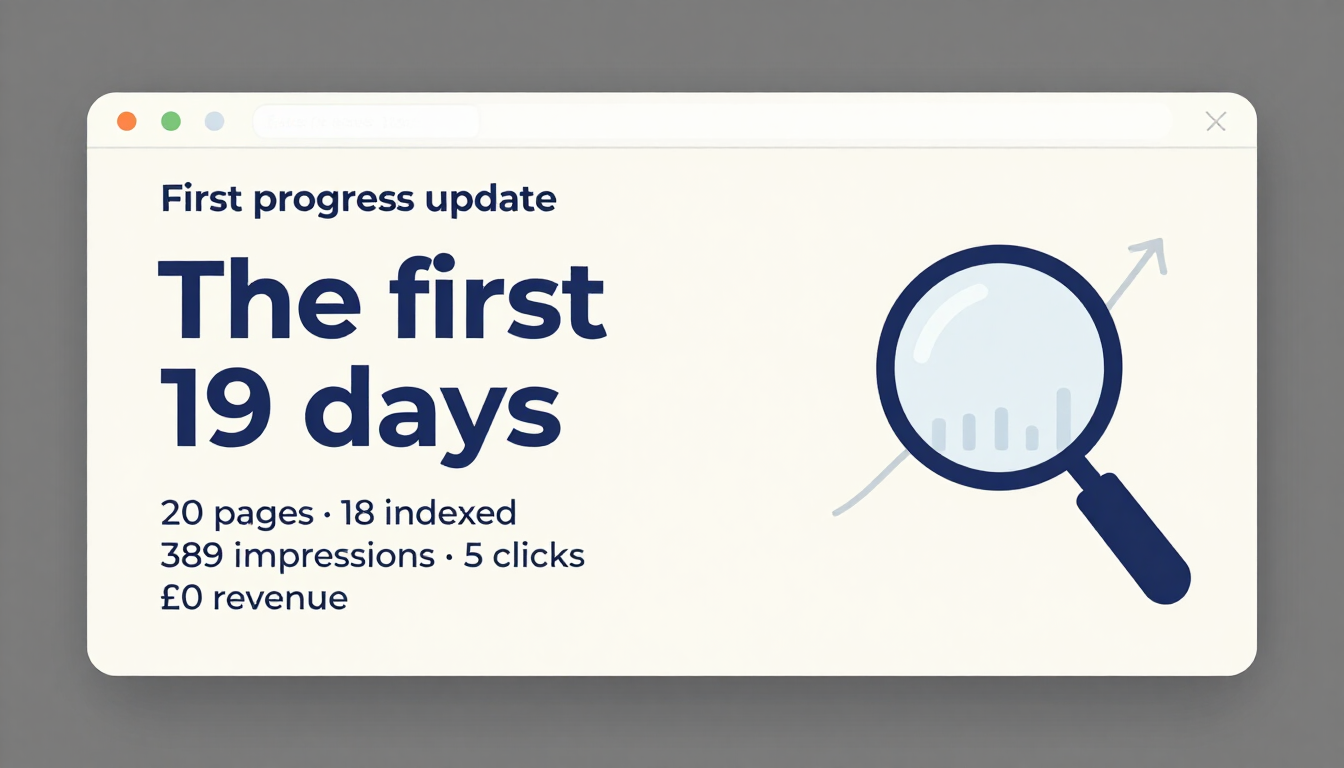
Earned on the Side went live on 24 August 2026. This is the first progress update: a record of what was published, what Google has started to discover, what the project has cost and what still needs to be improved.
Nineteen days is far too early to reach a meaningful conclusion about whether the project will work. Search visibility normally develops over time, particularly for a new website without an established audience or history. The figures below are therefore a baseline rather than a result to celebrate or defend.
I want these updates to show the work and direction of the project without presenting normal early movement as success. At the end of this first period, the website has pages in Google's index and has begun receiving search impressions and a small number of clicks. It has not generated an application, conversion or revenue. That is the honest position after the first 19 days.
The first 19 days in numbers
| Measure | 24 August to 12 September 2026 |
|---|---|
| Published pages and articles | 20 |
| Pages indexed by Google | 18 |
| Indexation rate | 90% |
| Google Search impressions | 389 |
| Google Search clicks | 5 |
| Organic click-through rate | 1.29% |
| Average Google position | 46 |
| Confirmed applications or conversions | 0 |
| Revenue earned | £0 |
| Direct project costs | £46 |
| Approximate time invested | 20 hours |
| Website users or sessions | Not yet confirmed |
| Referral-link clicks | Not yet tracked reliably |
The table is intentionally simple. It records what can currently be measured and identifies two gaps rather than inventing numbers for them. Website users and sessions have not yet been confirmed, while referral-link clicks are not yet tracked reliably enough to report.
What I published
The website reached 20 published pages and articles during the reporting period. The work has focused on establishing the initial structure of Earned on the Side and creating a useful base of evidence-led reviews, referral offers and supporting information.
Publishing 20 pages is not, by itself, a measure of quality or progress. A website can contain a large number of pages without answering useful questions or attracting the right audience. At this stage, the page count mainly shows that the first version of the site now has enough substance for search engines and readers to begin assessing it.
The priority has been to make each commercial page clear about the offer, qualification requirements and affiliate relationship. Wherever I have direct experience of a product or application process, the page should explain that experience rather than presenting generic claims as personal evidence.
Work since launch has included:
- Refining copy and page structure.
- Improving referral-offer explanations and eligibility wording.
- Separating pages where similar search terms represent different user intentions.
- Strengthening titles, metadata, headings and internal links.
- Improving page components and responsive layouts.
- Testing application links and calls to action.
- Checking indexing, canonical URLs and sitemap behaviour.
- Correcting technical and presentation issues found after launch.
This remains Foundation work. The website is becoming more complete, but the project has not yet produced enough performance data to justify moving into the next phase.
What Google has discovered so far
Google has indexed 18 of the 20 published pages, giving the site a 90% indexation rate at the end of the period. Indexing does not mean a page will rank prominently or generate traffic. It means Google has found and accepted the page into its index, making it eligible to appear for relevant searches.
The site recorded 389 Google Search impressions and five clicks. An impression means that a page from Earned on the Side appeared in a search result viewed by a user. It does not mean the result was near the top of the page or that the user seriously considered it.
Five clicks from 389 impressions produces an early organic click-through rate of approximately 1.29%. The average position was 46, which indicates that much of the current visibility is still several pages away from the leading results.
These figures are modest, but that is not unexpected after 19 days. The useful point is that search discovery has begun. The next task is to learn which pages continue earning impressions, whether their positions improve and whether searchers find the results relevant enough to visit.
I am deliberately not publishing individual search terms or commercially sensitive partner-level performance. Future updates will focus on aggregate visibility, movement and broader content categories.
No conversions and no revenue
Earned on the Side has not recorded a confirmed application, conversion or referral payment during this first reporting period. Revenue remains £0.
It would be easy to treat the lack of early income as evidence that the idea is not working, or to treat a handful of impressions as evidence that it is. Neither conclusion would be credible.
Commercial pages need to be discovered, rank for relevant searches, attract the right visitor, earn sufficient trust and send that visitor to a partner. The partner must then accept the application and determine whether its conditions have been completed. Nineteen days provides very little opportunity for that sequence to develop.
For now, the absence of revenue is simply the baseline. If the project remains at £0 after sustained visibility and meaningful referral-link activity, that will become more informative. At this stage, the site does not yet have enough traffic or tracking data to diagnose a conversion problem.
What the project has cost
Direct costs total £46:
- £26 for the domain.
- £20 for ChatGPT.
I have also invested approximately 20 hours. That estimate includes content refinements, coding changes, SEO improvements and testing since launch.
Time is the largest practical investment even when it does not appear as a cash expense. The project is being built alongside a full-time job, so the relevant question is not simply whether an activity is useful. It is whether that activity deserves a limited number of available hours.
The long-term objective is to develop repeatable processes and use automation carefully where it can reduce repetitive work. That does not remove the need for human review, particularly when pages include personal experience, financial conditions or information that can change.
What has gone well
The clearest early achievement is that the site is operational and most of its published pages have been indexed. The project has moved beyond planning into a real website with measurable search activity.
The launch has also exposed issues that were difficult to identify while the site existed only as a plan. Copy has been tightened, layouts have been refined, related pages have been separated more clearly and technical SEO details have been checked in a live environment.
The website's structure now provides a stronger base for future experiments. Pages can be updated, new offers can be added and early performance can be compared against a defined starting point.
What remains weak
Search visibility is still limited. An average position of 46 means the site is generally not competing near the top of the results, and five clicks is not enough traffic to assess user behaviour or commercial performance.
Measurement also needs improvement. Website users and sessions have not yet been confirmed, and referral-link clicks are not tracked reliably enough to report. Those gaps matter because future conversion analysis depends on understanding the complete journey:
- 1
A page appears in search.
- 2
A searcher visits the website.
- 3
The visitor engages with the page.
- 4
The visitor selects a referral link.
- 5
A partner records an application or qualifying action.
Search Console currently provides evidence for the beginning of that journey. Better analytics and outbound-click measurement are needed for the middle.
The next priorities
The immediate objective is not to publish as many pages as possible. It is to strengthen the existing foundation and collect better evidence.
Priorities for the next reporting period are:
- Confirm website analytics are recording users and sessions correctly.
- Add reliable event tracking for outbound referral-link clicks.
- Monitor the two pages that are not yet indexed and diagnose any persistent issue.
- Continue improving pages that receive impressions but sit outside useful ranking positions.
- Review search-result titles and descriptions for pages earning impressions but few clicks.
- Maintain offer accuracy and update time-sensitive terms only after checking them.
- Improve internal linking between related articles without creating competing pages for the same intent.
- Continue testing the website on desktop and mobile.
- Avoid publishing content purely to increase the article count.
The project will remain in the Foundation phase until its measurement, content base and maintenance process are reliable enough to support meaningful validation.
A baseline, not a verdict
After 19 days, Earned on the Side has 20 published pages, 18 indexed pages, 389 search impressions, five clicks, no confirmed conversions and no revenue. Direct costs are £46 and the approximate time investment is 20 hours.
Those numbers are neither impressive nor alarming. They are the first honest record of a new website beginning to exist in search.
The next update should be more useful because it will have this baseline for comparison. The questions will be whether visibility is increasing, whether more pages are reaching useful positions, whether visitors are selecting referral links and whether any part of the project shows enough promise to justify additional time.
Until then, the work remains simple: improve the foundation, measure what happens and avoid pretending that an early signal is a finished result.
Read more about the project
The full project brief, reporting approach and disclosure boundaries are set out on the project page.